Season 1 – Specimen #5
🔊 Listen to the pronunciation
B2 · Listening
Get ready to listen.
Before you listen, think about this:
Would you learn a language that isn’t the official language of any country? Why—or why not?
Now make a prediction.
Why do you think people learn Esperanto? Choose TWO possibilities.
A. It can help them get better jobs.
B. They like the idea behind the language.
C. It is easier to learn than many other languages.
D. It is useful when visiting a particular country.
E. Most international companies require it.
Don’t worry about names, numbers or details yet. Concentrate on the main message.
Which statement best summarizes the program?
A. Esperanto failed because it never became the official language of a country.
B. Esperanto was created as a simple international language, and people continue to learn it for both its ideals and its accessibility.
C. Esperanto is becoming more popular than other European languages because of language-learning apps.
D. Esperanto is mainly useful for people who travel frequently.
✅ B is the best answer.
The program explains why Esperanto was created, why people still learn it, and how speakers use the language to connect with people around the world.
1. What do the colors of the Esperanto flag represent?
A. Nature and freedom
B. Hope and peace
C. Europe and unity
D. Language and culture
✅ B — hope and peace
Green represents hope; white represents peace.
2. What was Ludwig Zamenhof’s profession?
A. Language teacher
B. University professor
C. Eye doctor
D. Politician
✅ C — eye doctor
3. What experience influenced Zamenhof’s idea for Esperanto?
A. He found foreign languages extremely difficult to learn.
B. He lived among communities that did not speak one another’s languages.
C. He traveled extensively for his work.
D. He wanted Polish people to communicate internationally.
✅ B — he lived among communities that did not speak one another’s languages.
Zamenhof believed these language barriers contributed to arguments and conflict.
4. Approximately how many Esperanto speakers are there today?
A. 200,000
B. 500,000
C. 1 million
D. 2 million
✅ D — about two million
5. Why is Esperanto described as particularly easy to learn?
A. It uses vocabulary entirely from English.
B. It has no grammar.
C. It has 16 basic rules, no irregular forms and about 1,000 root words.
D. Speakers don’t need to conjugate verbs.
✅ C — 16 basic rules, no irregular forms and about 1,000 root words.
Can you catch what was actually said?
Esperanto was created by a __________ eye doctor named Ludwig Zamenhof. He believed that better __________ between people from different __________ could help reduce conflict and promote understanding.
Today, around __________ people speak Esperanto. Learners can attend international conferences and other events where they have opportunities to __________ speaking and listening.
One reason Esperanto attracts learners is that it is relatively __________ to learn. It has only 16 basic rules and no __________ forms. However, many speakers are also attracted to the ideals behind the language, including hope and __________.
Esperanto was created by a Polish eye doctor named Ludwig Zamenhof. He believed that better communication between people from different cultures could help reduce conflict and promote understanding.
Today, around two million people speak Esperanto. Learners can attend international conferences and other events where they have opportunities to practise speaking and listening.
One reason Esperanto attracts learners is that it is relatively easy to learn. It has only 16 basic rules and no irregular forms. However, many speakers are also attracted to the ideals behind the language, including hope and peace.
Zamenhof believed that a shared language could help people from different cultures understand one another better.
What do you think?
Do we still need a shared international language today?
Does speaking the same language necessarily help people understand one another?
Would you personally consider learning Esperanto? Why or why not?
B2 • Grammar
Something has contaminated these sentences. But what?
❌ I have been in London last year.
Can you find the contamination?
✅ I was in London last year.
Why? Last year refers to a finished time in the past, so we use the past simple, not the present perfect.
❌ She suggested me to apply for the job.
Can you find the contamination?
✅ She suggested that I apply for the job.
or
✅ She suggested applying for the job.
Why? We don’t normally use suggest + person + to-infinitive. Use suggest + -ing or suggest + that-clause.
❌ I’m looking forward to see you next week.
Can you find the contamination?
✅ I’m looking forward to seeing you next week.
Why? In look forward to, to is a preposition, so it is followed by a noun or an -ing form:
look forward to + noun / -ing
❌ Despite of the rain, we decided to go for a walk.
Can you find the contamination?
✅ Despite the rain, we decided to go for a walk.
Why? Despite doesn’t take of.
despite + noun
in spite of + noun
So we can also say:
✅ In spite of the rain, we decided to go for a walk.
❌ I didn’t know where was the meeting.
Can you find the contamination?
✅ I didn’t know where the meeting was.
Why? In an indirect question, we use normal statement word order:
where + subject + verb
Direct question: Where was the meeting?
Indirect question: I didn’t know where the meeting was.
B2 • Writing
Your experiment:
When I opened the door, everyone suddenly stopped talking. 😱😱😱
What happened next? Add at least three sentences to tell an engaging story.
B2 · Reading
Before you read, take a quick look.
Look at the title: Why We Put Things Off
What do you expect the text to discuss?
A. Why people forget important information
B. Why people delay doing things
C. Why people need more free time
D. Why some people work faster than others
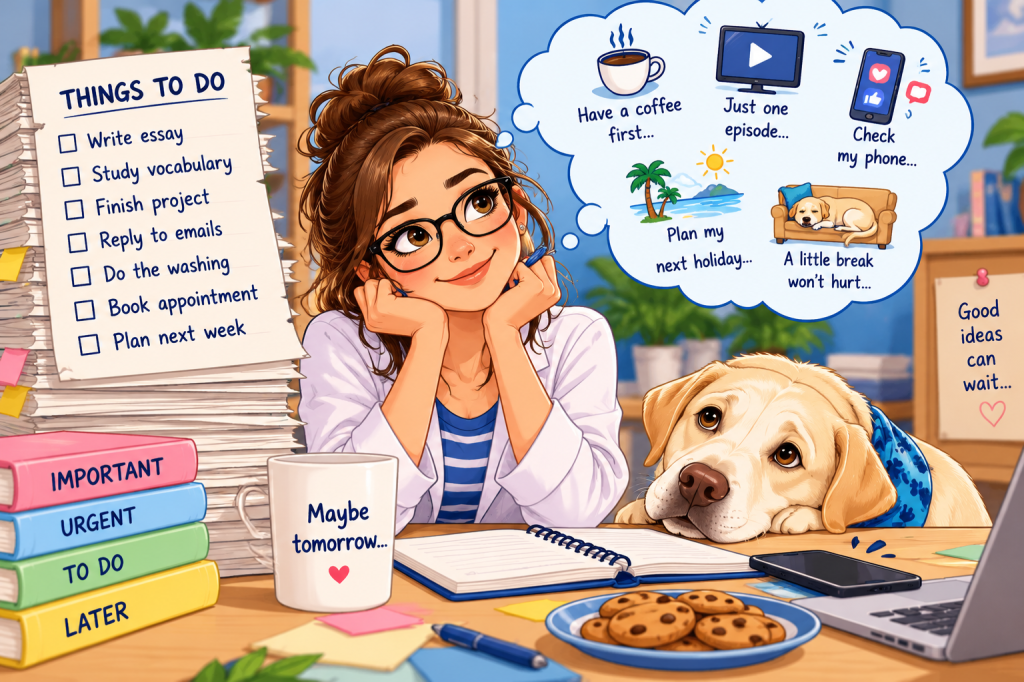
Read once for the big picture. Don’t worry about understanding every word.
You have an important report to finish. You know the deadline is approaching, and you have promised yourself that today you will finally make some progress. You sit down at your desk, open the document—and suddenly remember that you should check your email. Twenty minutes later, you are watching a video that has absolutely nothing to do with your report.
Sound familiar?
We often think of procrastination as poor time management or laziness. However, researchers who study procrastination suggest that the problem may have more to do with managing our emotions than managing our time.
Some tasks make us feel uncomfortable. They may be boring, difficult, confusing, or so important that we are afraid of doing them badly. Avoiding the task provides temporary relief from those unpleasant feelings. Checking social media or making another cup of coffee feels better than staring at a difficult spreadsheet. The problem, of course, has not disappeared. We have simply postponed both the task and the discomfort associated with it.
This can create a cycle. The longer we delay, the more stressful the task becomes. As the deadline gets closer, we may feel guilty about the time we have wasted. That additional stress makes the task even less appealing, so we become even more tempted to avoid it.
One way to break the cycle is to make the first step extremely small. Instead of telling yourself to finish the report, you might decide to open the document and write one paragraph. A smaller task feels less threatening, which makes it easier to begin. And beginning matters. Once we start, continuing is often easier than we expected.
This doesn’t mean that motivation is useless. But waiting until you feel like doing something can be risky. Sometimes action has to come first. Motivation may follow.
Which statement best summarizes the text?
A. Procrastination happens mainly because people don’t organize their schedules properly.
B. Difficult tasks should be divided equally across several days.
C. Procrastination is often connected with avoiding uncomfortable feelings, and taking a small first step can help.
D. People procrastinate because modern technology provides too many distractions.
✅ C
The text explains that procrastination is often connected with avoiding unpleasant emotions rather than simply poor time management. It also suggests making the first step very small.
Read the text again and examine its details.
A. They don’t understand the deadline.
B. The task creates uncomfortable feelings.
C. They believe the task is unnecessary.
D. They need more information before beginning.
✅ B — Tasks that are boring, difficult, confusing, or important can create uncomfortable emotions that we want to avoid.
A. Delaying the task creates additional stress, which can make us want to avoid it even more.
B. People eventually forget why the task was important.
C. Deadlines usually become less important over time.
D. Taking breaks makes difficult tasks seem longer.
✅ A
A. Wait until you feel motivated.
B. Remove every possible distraction.
C. Make the first step very small and manageable.
D. Work only when the deadline is close.
✅ C
Don’t reach for the dictionary yet. Use the surrounding words as evidence.
Avoiding the task provides temporary relief from those unpleasant feelings.
What does relief most likely mean here?
A. a feeling of comfort when something unpleasant is reduced
B. a sudden increase in pressure
C. an excuse for avoiding responsibility
D. an unexpected problem
✅ A
That additional stress makes the task even less appealing.
What does appealing mean here?
A. urgent
B. complicated
C. attractive or pleasant
D. familiar
✅ C
A smaller task feels less threatening, which makes it easier to begin.
What does threatening suggest in this sentence?
A. likely to cause physical harm
B. intimidating or difficult to face
C. completely unnecessary
D. impossible to understand
✅ B
The answer isn’t stated directly. What can you infer?
The writer says:
“Sometimes action has to come first. Motivation may follow.”
What is the writer suggesting?
A. Motivation isn’t important at all.
B. We should always force ourselves to work.
C. Starting a task can sometimes create the motivation to continue.
D. Motivated people don’t procrastinate.
✅ C
The writer is suggesting that we don’t necessarily need to feel motivated before beginning. Taking action may help create momentum and make continuing easier.
Now look at the idea from your perspective.
And most importantly:
They may look harmless—but look closer. These two words do very different jobs.
Examine the samples. What do you notice?
A. I thought the meeting started at 10:00, but it actually starts at 11:00.
B. We’re currently looking for someone to lead the project.
C. She looks very serious, but she’s actually quite funny.
D. The laboratory is currently closed for renovations.
Which word refers to now / at the present time?
Which word introduces the real or surprising truth?
currently → now; at the present time
actually → in fact; really; contrary to what someone thought or expected
ACTUALLY
Use actually when you want to correct an assumption, introduce the real situation, or say something that may be surprising.
I assumed he was American, but he’s actually Canadian.
The exam wasn’t difficult. Actually, it was surprisingly easy.
CURRENTLY
Use currently to talk about something happening or being true at the present time.
I’m currently working on a new project.
The museum is currently closed.
Same sentence structure. One small word changes the message.
She is actually working in London.
= The truth is that she works in London—perhaps contrary to what you thought.
She is currently working in London.
= She is working in London at the moment.
⚠️ Polish aktualnie does not mean English actually.
aktualnie → currently / at present
actually → właściwie / tak naprawdę / w rzeczywistości
❌ I’m actually working from home.
if you mean Aktualnie pracuję z domu.
✅ I’m currently working from home.
Choose ACTUALLY or CURRENTLY.
1. actually — contrasts with the original expectation
2. currently — happening now
3. actually — corrects previous information
4. currently — true at the present time
5. Actually — introduces a surprising contrast
Some words are naturally drawn together.
at first → initially
at least → as a minimum / anyway
at risk → in danger
at fault → responsible for something going wrong
at ease → relaxed and comfortable
at present → now, currently
at random → without a particular plan or pattern
at short notice → with very little warning
❌ in present
✅ at present❌ in risk
✅ at risk❌ on random
✅ at random
Use one of the phrases in the following sentences:
at first · at risk · at ease · at random · at present · at fault · at short notice
1. I felt nervous during the first few minutes of the interview, but the interviewer quickly made me feel __________.
at ease
2. The researchers didn’t choose participants based on age or occupation; they selected them __________.
at random
3. __________, I thought the assignment would be easy, but it turned out to be much more complicated than I expected.
at first
4. Without additional funding, several community programs could be __________.
at risk
5. Thanks for agreeing to cover my shift __________. I know I didn’t give you much time to rearrange your plans.
at short notice


Leave a Reply