B2 · Reading
👁️ First Glance
Before you read, take a quick look.
Look at the title: Why We Put Things Off
What do you expect the text to discuss?
A. Why people forget important information
B. Why people delay doing things
C. Why people need more free time
D. Why some people work faster than others
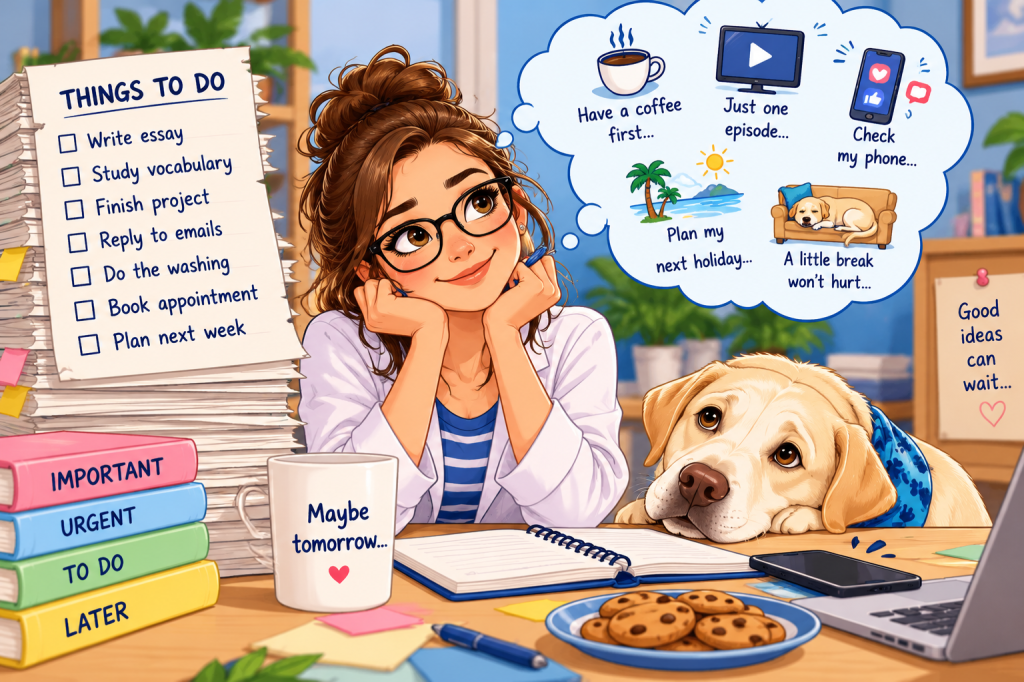
🔎 Wide-Angle Lens
Read once for the big picture. Don’t worry about understanding every word.
Why We Put Things Off
You have an important report to finish. You know the deadline is approaching, and you have promised yourself that today you will finally make some progress. You sit down at your desk, open the document—and suddenly remember that you should check your email. Twenty minutes later, you are watching a video that has absolutely nothing to do with your report.
Sound familiar?
We often think of procrastination as poor time management or laziness. However, researchers who study procrastination suggest that the problem may have more to do with managing our emotions than managing our time.
Some tasks make us feel uncomfortable. They may be boring, difficult, confusing, or so important that we are afraid of doing them badly. Avoiding the task provides temporary relief from those unpleasant feelings. Checking social media or making another cup of coffee feels better than staring at a difficult spreadsheet. The problem, of course, has not disappeared. We have simply postponed both the task and the discomfort associated with it.
This can create a cycle. The longer we delay, the more stressful the task becomes. As the deadline gets closer, we may feel guilty about the time we have wasted. That additional stress makes the task even less appealing, so we become even more tempted to avoid it.
One way to break the cycle is to make the first step extremely small. Instead of telling yourself to finish the report, you might decide to open the document and write one paragraph. A smaller task feels less threatening, which makes it easier to begin. And beginning matters. Once we start, continuing is often easier than we expected.
This doesn’t mean that motivation is useless. But waiting until you feel like doing something can be risky. Sometimes action has to come first. Motivation may follow.
🗺️ The Big Picture
Which statement best summarizes the text?
A. Procrastination happens mainly because people don’t organize their schedules properly.
B. Difficult tasks should be divided equally across several days.
C. Procrastination is often connected with avoiding uncomfortable feelings, and taking a small first step can help.
D. People procrastinate because modern technology provides too many distractions.
📢 Reveal the Wide-Angle View
✅ C
The text explains that procrastination is often connected with avoiding unpleasant emotions rather than simply poor time management. It also suggests making the first step very small.
🔬 Zoom In
Read the text again and examine its details.
1. According to the text, why might someone avoid an important task?
A. They don’t understand the deadline.
B. The task creates uncomfortable feelings.
C. They believe the task is unnecessary.
D. They need more information before beginning.
📢 Reveal the Detail
✅ B — Tasks that are boring, difficult, confusing, or important can create uncomfortable emotions that we want to avoid.
2. Why can procrastination become a cycle?
A. Delaying the task creates additional stress, which can make us want to avoid it even more.
B. People eventually forget why the task was important.
C. Deadlines usually become less important over time.
D. Taking breaks makes difficult tasks seem longer.
📢 Reveal the Detail
✅ A
3. What solution does the writer suggest?
A. Wait until you feel motivated.
B. Remove every possible distraction.
C. Make the first step very small and manageable.
D. Work only when the deadline is close.
📢 Reveal the detail
✅ C
🧭 Context Clues
Don’t reach for the dictionary yet. Use the surrounding words as evidence.
1. relief
Avoiding the task provides temporary relief from those unpleasant feelings.
What does relief most likely mean here?
A. a feeling of comfort when something unpleasant is reduced
B. a sudden increase in pressure
C. an excuse for avoiding responsibility
D. an unexpected problem
📢 Reveal the clue
✅ A
2. appealing
That additional stress makes the task even less appealing.
What does appealing mean here?
A. urgent
B. complicated
C. attractive or pleasant
D. familiar
📢Reveal the clue
✅ C
3. threatening
A smaller task feels less threatening, which makes it easier to begin.
What does threatening suggest in this sentence?
A. likely to cause physical harm
B. intimidating or difficult to face
C. completely unnecessary
D. impossible to understand
📢Reveal the clue
✅ B
🕵️ Between the Lines
The answer isn’t stated directly. What can you infer?
The writer says:
“Sometimes action has to come first. Motivation may follow.”
What is the writer suggesting?
A. Motivation isn’t important at all.
B. We should always force ourselves to work.
C. Starting a task can sometimes create the motivation to continue.
D. Motivated people don’t procrastinate.
📢Reveal the answer
✅ C
The writer is suggesting that we don’t necessarily need to feel motivated before beginning. Taking action may help create momentum and make continuing easier.
🔭 Change the Lens
Now look at the idea from your perspective.
- Think about something you tend to postpone.
- What do you usually put off?
- Why do you think you avoid it?
And most importantly:
- What would the smallest possible first step be?

